 jeffbonar
If your home’s cold and your furnace or heat pump isn’t keeping up, start with the checks below. Most take under a minute, and several of them fix the problem without a service call: a thermostat setting, a tripped breaker, a clogged filter, a closed vent. They work for gas furnaces and heat pumps alike, and steps 6 through 8 cover the differences between the two. If you smell gas, hear booming or grinding, or a CO alarm is sounding, skip the list. Leave the house and call from outside. If the checks don’t bring the heat back, Ross & Witmer handles heating repair across Charlotte, with 24/7 emergency service.
Before you start: safety first
- If you smell gas or a CO alarm is going off, exit the home and call us or your gas utility from outside.
- Do not remove burner doors, reach into moving parts, or bypass a safety switch.
- If a step makes you uncomfortable, stop there and call Ross & Witmer.
1) Thermostat check
Set the thermostat to HEAT and put the setpoint at least 3 to 5 degrees above the room temperature. Set the fan to AUTO, not ON. A fan left on ON blows room-temperature air between heating cycles, which feels exactly like a broken heater. If the display is dim or blank, replace the batteries. If it’s a Wi-Fi model, confirm it’s still connected, because a thermostat that dropped off the network can keep running an old schedule.
If the system responds to a big setpoint change but ignores small ones, or the room feels colder than the number on the wall, the thermostat itself may be the problem. On a heat pump, the thermostat also has to be set up for heat pump operation so it can control the outdoor unit and the backup heat.
2) Power and breakers
Check the service switch near the indoor unit first. It looks like an ordinary light switch and gets flipped by accident more often than you’d expect. Then check the breaker labeled furnace or air handler, and for a heat pump, the separate outdoor-unit breaker. Reset a tripped breaker once. If it trips again, leave it off and call. A breaker that keeps tripping is reporting a fault somewhere in the system.
3) Air filter and returns
A clogged filter is one of the most common reasons a system runs but blows cool air. Restricted airflow overheats a furnace and trips a safety limit, which shuts off the burner and leaves the blower running. Replace the filter if it’s dirty, and check that return grilles aren’t blocked by furniture, rugs, or holiday decorations.
4) Vents and dampers
Open supply vents at least 80 percent in the rooms you use. Closing vents to save money raises duct pressure and can trip the same safety limits a dirty filter does. If your ductwork has manual dampers, set them to the heating position.
5) Condensate overflow switch
High-efficiency furnaces and most air handlers have a float switch that cuts power when the drain pan fills. Look for standing water in the pan. If it’s full, turn off power and call for service rather than defeating the switch, because the water is backing up for a reason.
6) Gas furnace: ignition and gas supply
If the burner never lights, the cause is usually ignition or gas supply. The gas valve at the furnace should sit parallel with the pipe when it’s open. Do not force it. On an older furnace with a standing pilot that has gone out, don’t relight it unless you’re fully comfortable doing so. A furnace that starts and stops every few minutes, called short cycling, usually has a safety device tripping and needs a technician.
7) Heat pump: defrost is normal, ice is not
On a cold, damp Charlotte morning your outdoor unit will steam and pause for a few minutes. That’s a defrost cycle, and it’s supposed to happen. A light coat of frost on the coil is normal too. What isn’t normal: the outdoor fan never spinning, the coil encased in solid ice, or the unit running nonstop without ever reaching the setpoint. Do not chip ice off the coil, because the tubing behind the fins punctures easily.
8) Emergency Heat and AUX
Emergency Heat switches your system to electric resistance strips, a backup that costs far more to run than the heat pump. Use it only when the heat pump won’t run at all, and switch it off once the system is repaired. A heat pump that has quietly failed can keep the house warm on backup heat while the bill climbs, so many homeowners don’t notice a problem until the statement arrives. If your home only stays warm with Emergency Heat on, the heat pump needs service even though the house feels fine.
9) Odors and noises
A burnt-dust smell for the first few minutes of the season is normal as dust burns off the heat exchanger. A sharp electrical smell, metallic scraping, or a boom at ignition is not. Shut the system down and call.
10) What a professional heating diagnosis should cover
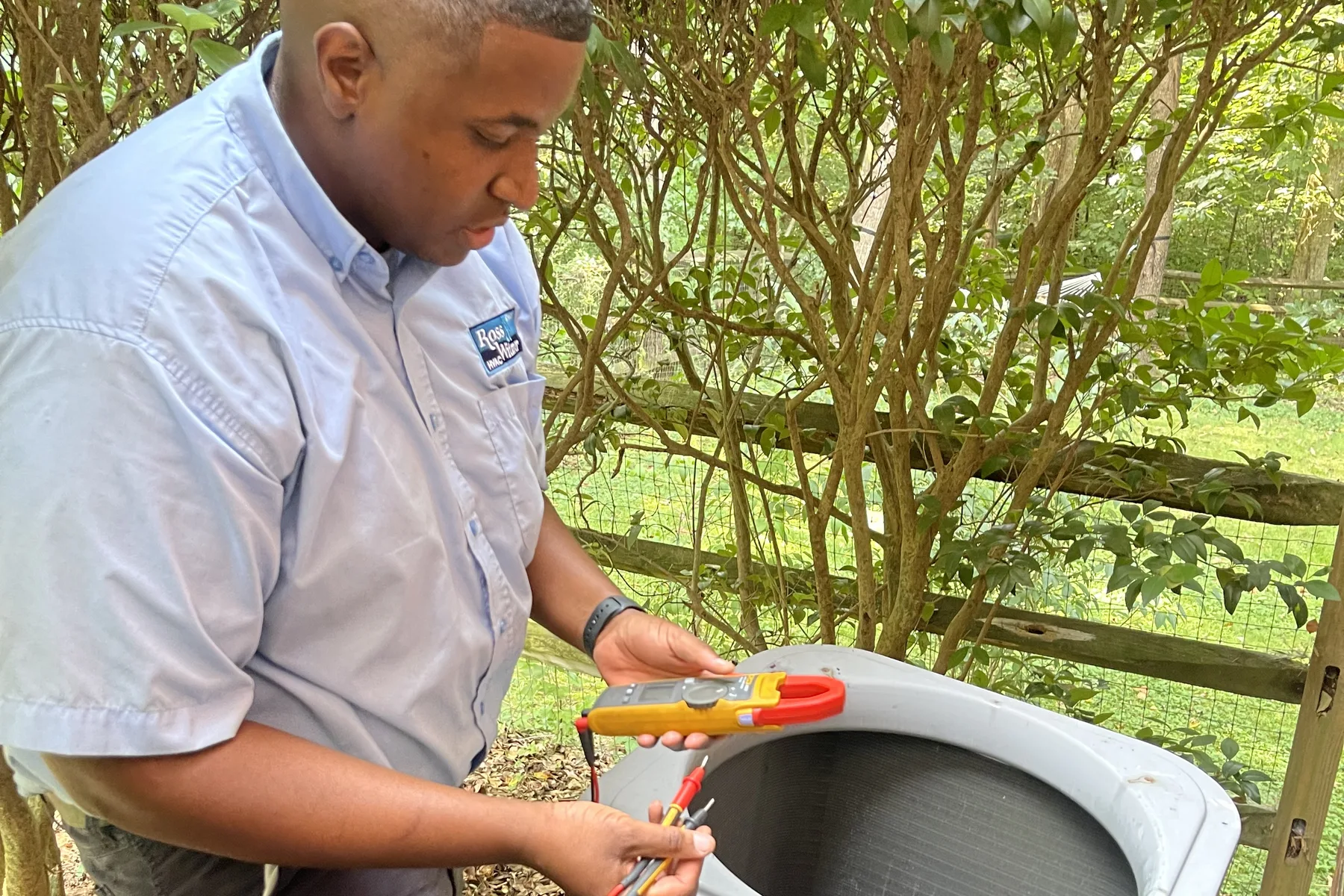
When the checks above don’t solve it, a good diagnosis is a set of measurements, not a guess. On any system, expect the technician to check the thermostat call and wiring, airflow and static pressure, the temperature rise across the furnace or coil, capacitors and motors, and every safety switch that might be tripping. On a gas furnace that adds the ignition sequence and flame signal. On a heat pump it adds refrigerant pressures and defrost operation. If a technician names a part without testing anything, it’s fair to ask what they measured.
We repair and maintain furnaces and heat pumps across Charlotte, Gastonia, Huntersville, Matthews, Mint Hill, and nearby communities.
How much does heating repair cost in Charlotte?
Most furnace repairs in Charlotte cost $125 to $449, with an average of about $273, according to Angi’s Charlotte data (updated August 2026). Angi puts local labor at $50 to $150 an hour, and $150 to $215 an hour for emergency or after-hours service. Those are market estimates, not Ross & Witmer’s prices.
A no-heat call is a diagnostic or service-call fee plus parts and labor for whatever the diagnosis finds. Common repairs are small parts: a capacitor, a flame sensor, a limit switch, a contactor, a thermostat. When you call any company, ask what the service-call fee is, whether it’s credited toward the repair, and whether nights and weekends are billed differently.
Is it time to replace instead of repair?
Repair is usually the right call. Replacement starts to make more sense when the system is past its expected life (about 10 years for a heat pump and 15 for a furnace here), when a single repair approaches 30 to 40 percent of the cost of new equipment, when a heat pump needs a compressor, or when a furnace has a cracked heat exchanger.
Ask for repair and replacement prices side by side so you can compare them. If you’re weighing a new system, our guide to choosing between a heat pump and a gas furnace in Charlotte covers what each costs to install here and which suits a Charlotte winter.
Clear next steps
- Need heat today? Contact Ross & Witmer or call 704-392-6188 for heating repair. We’re rated 4.9 across more than 430 Google reviews.
- Want to avoid the next breakdown? Ask about a maintenance plan.
- Comparing repair against a new system? Read our heat pump versus gas furnace guide.
- Cooling season problem? See our guide to emergency AC repair in summer.
Frequently Asked Questions
Why is my furnace blowing cold air?
The usual causes are a fan set to ON instead of AUTO, a clogged filter tripping a high-limit switch, or an ignition failure. Set the fan to AUTO and replace the filter first. If the burner still never lights, the system needs a diagnosis.
My heat pump is steaming and stopped heating. Is it broken?
Probably not. In cold, humid weather a heat pump runs a defrost cycle that produces visible steam and pauses heating for a few minutes. Call for service if the outdoor fan never runs, the coil is encased in ice, or the pause never ends.
Why is my electric bill so high with a heat pump?
Often it’s because the heat pump isn’t doing the work. Most air handlers have electric resistance strips as backup heat. Running on Emergency Heat means “paying two to three times as much for that heat” as using the heat pump, according to building-science consultant Allison Bailes of Energy Vanguard. When a heat pump fails, the strips take over and the house stays warm, so nothing seems wrong until the bill arrives. A high winter bill with no change in your habits is worth a diagnosis.
How often should I change my filter during a Charlotte winter?
Check it monthly and replace it every one to three months, depending on the filter type, pets, and dust. A one-inch filter needs changing more often than a four-inch media filter.
Does Ross & Witmer offer after-hours heating repair in Charlotte?
Yes. Ross & Witmer offers 24/7 emergency repair and service. Call 704-392-6188 any time your heat goes out, and ask when you call how after-hours visits are billed.