
 jeffbonar
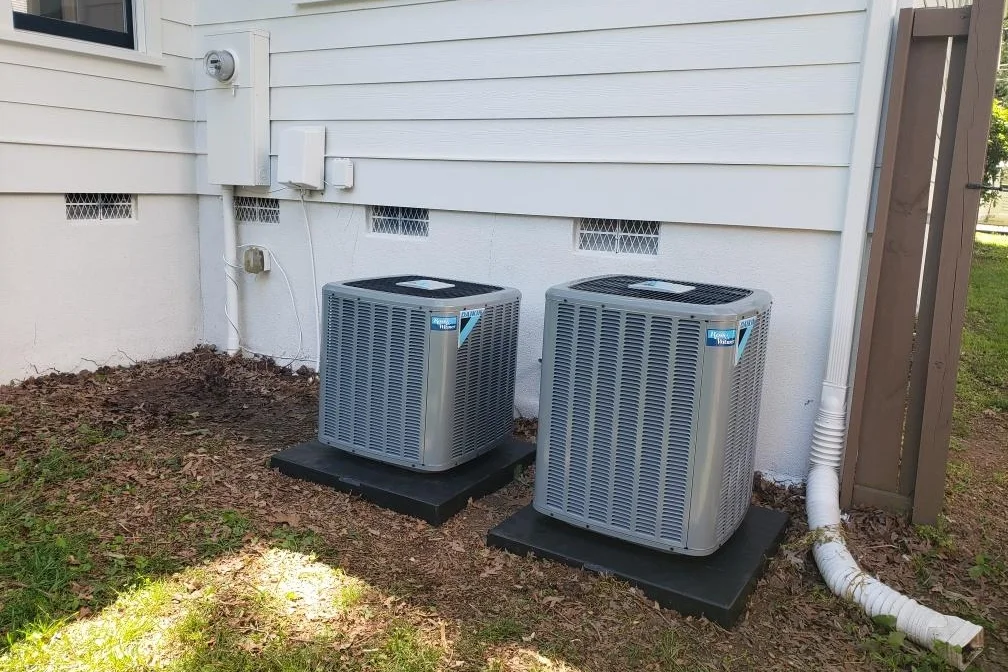
For most Charlotte homes, a heat pump is the better fit. Mecklenburg County’s winter design temperature is 22°F, which is mild enough for a heat pump to carry the house through nearly every hour of a normal winter, and a heat pump handles your cooling too. A gas furnace still makes sense if you already have natural gas service and a furnace in good shape, or if you want noticeably hotter air at the vents. This guide covers how each system handles a Charlotte winter, what each one costs to install in 2026, when dual fuel is worth it, and how to decide between repairing and replacing.
How a heat pump and a gas furnace heat your home
A gas furnace burns fuel to make heat. Its efficiency rating (AFUE) is the share of that fuel that becomes heat in your home, so it’s always below 100 percent. A heat pump doesn’t burn anything. It moves heat from the outdoor air into the house, so it delivers more heat energy than the electricity it uses. That’s why a heat pump usually costs less to run in a mild winter.
The trade-off is that a heat pump’s output drops as the outdoor temperature falls. So the real question for any home is how cold it gets there, and how often. That’s where Charlotte’s design temperature comes in.
What Charlotte’s 22°F design temperature means
ENERGY STAR’s Design Temperature Limit Reference Guide (2019 Edition) sets Mecklenburg County’s 99 percent heating design temperature at 22°F, using the Statesville Regional weather station. In a typical year, only about 1 percent of hours are colder than that. It’s the temperature heating equipment here is sized to handle.
A lot of heat pump advice online comes from much colder places, where a heat pump really does need a furnace behind it. Charlotte isn’t one of them. Cold-climate models go well past what a Charlotte winter asks for: Mitsubishi’s Hyper-Heating (H2i) heat pumps, for example, are rated at 100 percent capacity down to 5°F. Charlotte does get the occasional single-digit morning, and that’s what backup heat is for. A standard heat pump uses electric strips for those hours; a dual fuel system uses a gas furnace.
What a heat pump or furnace replacement costs in 2026
HomeGuide’s 2026 cost guides put a new air-source heat pump at $10,000 to $25,000 installed, and $10,000 to $20,000 for a typical 2,000 square foot home (about 3 tons). A new gas furnace runs $3,500 to $7,500 installed for a standard-efficiency model, and about $11,500 for a high-efficiency unit. These are national estimates, not Ross & Witmer’s prices, and a local quote can land above or below them.
When you compare the two, remember that a furnace only heats. A heat pump replaces both your furnace and your air conditioner, so the fair comparison is a heat pump against a furnace plus a new AC. These are the things that move a quote up or down:
| Cost factor | Why it moves the price |
|---|---|
| Capacity and efficiency tier | Size should come from a load calculation, not the old unit’s label |
| Single-stage, two-stage, or variable-speed | Variable-speed costs more up front and runs longer at low output, which keeps rooms more even |
| Ductwork condition | Leaky or undersized ducts waste efficiency and sometimes need sealing or changes |
| Electrical capacity | A heat pump with backup strips may need a circuit or panel upgrade |
| Line set, pad, thermostat, permits | The thermostat has to support heat pump controls and backup heat |
Paying for a new system in 2026
Ross & Witmer offers financing through GreenSky: 12 months at 0 percent interest, or 9.9 percent APR for 72 months, with approved credit.
There’s no federal tax credit on a 2026 installation. The 25C Energy Efficient Home Improvement Credit and the 25D Residential Clean Energy Credit both ended for equipment placed in service after December 31, 2025, per the IRS. If a quote still shows a federal credit, ask about it.
If Duke Energy is your electric company, check its Smart $aver program before you buy. It pays rebates on qualifying high-efficiency heat pumps, and a participating contractor has to do the work and submit the application, so ask about it when you get quotes.
When is a gas furnace the better choice?
A gas furnace is the right answer in some Charlotte homes:
- You already have natural gas and a sound furnace setup. Swapping one furnace for another is usually the simpler, cheaper project.
- You want hotter air at the vents. Building-science consultant Allison Bailes of Energy Vanguard puts heat pump supply air at usually 90°F to 110°F, and furnace air coming off the heat exchanger at around 150°F.
- Your electrical service can’t support backup strips without an upgrade that changes the math.
- Your air conditioner just failed but your furnace is fine. A heat pump paired with the existing furnace (dual fuel) is often the best move here. More on that below.
Here’s how the two compare side by side:
| Heat pump | Gas furnace | |
|---|---|---|
| Operating cost in a Charlotte winter | Usually lower | Usually higher |
| Cooling | Yes, one system does both | No, needs a separate AC |
| Air temperature at the vents | Warm (about 90°F to 110°F) | Hot (around 150°F off the heat exchanger) |
| Cold weather | Output drops as it gets colder; backup covers the coldest hours | Unaffected by outdoor temperature |
| Expected life | About 10 years | About 15 years |
| Needs a gas line | No | Yes |
The life expectancy figures are the ones Ross & Witmer uses on its heating installation page. The heat pump’s shorter number reflects how much it runs, not build quality: in Charlotte it heats all winter and cools all summer, while a furnace sits idle half the year.
Dual fuel: what it is and when it’s worth it
A dual fuel system pairs a heat pump with a gas furnace. The heat pump runs in mild weather, and the furnace takes over below a set outdoor temperature. In Charlotte, dual fuel is a good option, not a requirement.
It makes the most sense when you already own a working gas furnace and need to replace the air conditioner, because the furnace half is already paid for. The main benefit is that you avoid electric resistance strips for backup heat. Energy Vanguard estimates that running on strips alone costs two to three times as much as heat from the heat pump. Whether it pays off for you depends on your electric rate against your gas rate, so ask for the switchover temperature and the math behind it.
What size heat pump does my house need?
Size comes from a load calculation, not square footage alone and not the label on the old unit. A proper calculation accounts for square footage, insulation, window area and direction, air leakage, duct condition, and the local design temperature.
An oversized system heats or cools the house quickly, shuts off, and repeats. It never runs long enough to pull humidity out of the air or spread heat evenly, so you get hot and cold rooms and a clammy feel in spring and fall, and the equipment wears faster from constant cycling. HomeGuide’s rule of thumb is about 3 tons for a 2,000 square foot home, but two similar houses can need different sizes. Ask any contractor quoting you to show the load calculation behind the size they recommend.
Repair or replace?
Replacement usually makes more sense when one of these is true:
- The system is past its expected life: about 10 years for a heat pump or 15 for a furnace.
- A single repair approaches 30 to 40 percent of the cost of new equipment.
- A heat pump needs a compressor, or a furnace has a cracked heat exchanger.
- It’s the second major repair in two seasons.
- Your utility bills keep climbing while your habits haven’t changed.
For most other problems, repair is the right call. A capacitor, flame sensor, limit switch, or thermostat is a repair, even on an older system. If your system is down right now, start with our guide to a furnace or heat pump that isn’t heating in Charlotte.
Frequently Asked Questions
Will a heat pump keep my Charlotte house warm in winter?
Yes. Mecklenburg County’s 99 percent design temperature is 22°F, and heat pumps are routinely installed as the only heating in climates like Charlotte’s. Backup heat, either electric strips or a gas furnace, covers the few hours each winter that fall below what the heat pump can handle alone.
How much is a heat pump for a 2,000 square foot house?
HomeGuide’s 2026 guide puts a typical 2,000 square foot home at about 3 tons and $10,000 to $20,000 installed. Duct condition, efficiency tier, and electrical work move the final number.
Why don’t contractors like heat pumps?
Some have seen a lot of poorly installed ones. Two common problems cause most complaints: a system sized by square footage instead of a load calculation, which leaves the house uneven and clammy, and backup strips set to come on too early, which runs up the electric bill. Both come down to installation, not the equipment.
Do I need a new thermostat with a heat pump?
Often. The thermostat has to control the heat pump’s heating and cooling modes and its backup heat stages. If your current thermostat was set up for a furnace and AC, ask whether it supports heat pump operation.
Ready to compare your options?
Ross & Witmer has been installing heating systems in Charlotte since 1945, when businessman F.H. Ross, Sr. and Carrier Corporation engineer C.N. Witmer started the company. We’re rated 4.9 across more than 430 Google reviews, and our NATE-certified technicians can walk you through both options for your home. We serve Charlotte, Gastonia, Huntersville, Matthews, Mint Hill, and nearby communities.
Call 704-392-6188 or request service to schedule a heating installation consultation.